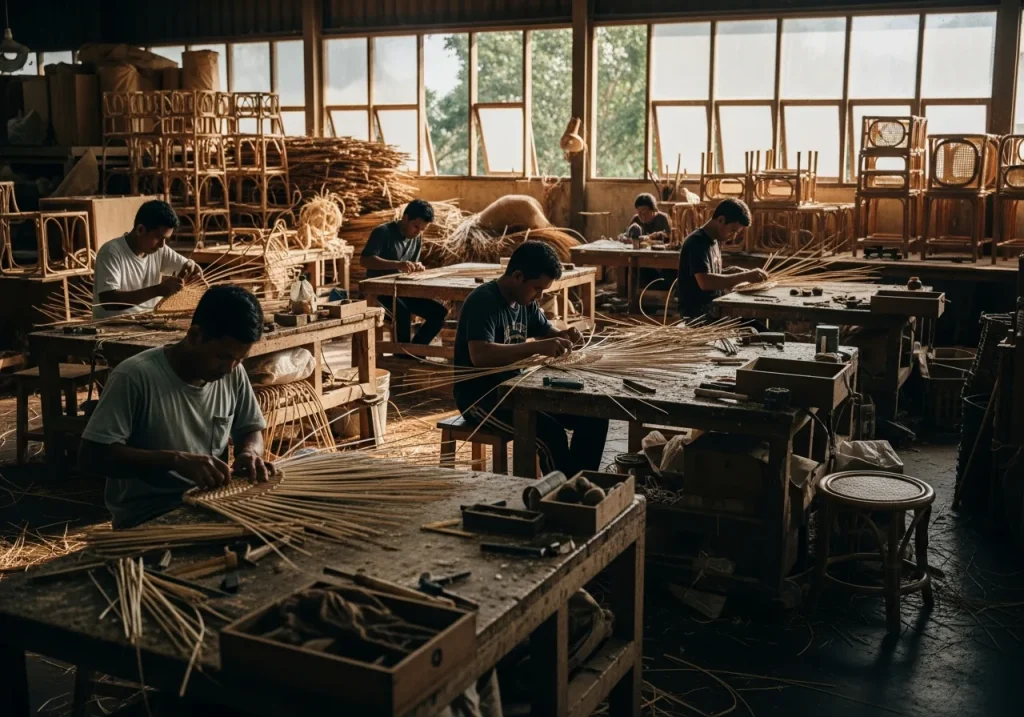
The global rattan furniture wholesale market is projected to reach approximately USD 15.2 billion by 2035, growing at a CAGR of about 5.2% from 2025. Indonesia, including Bali and Java, is the leading production and export hub, serving international buyers with container-scale orders of mid-range indoor and outdoor furniture.
As Ni Kadek Ariani, lead for a rattan weaving co-op and senior content lead for Bali Rattan Wholesale, I provide this comparison for importers, wholesalers, retailers, interior contractors, and trade buyers considering sourcing rattan furniture from Indonesia.
1. Market Size & Growth: Global to Indonesia
The global rattan furniture market is a mid-sized and growing segment, with various reports indicating strong growth and Asia-Pacific dominance. Estimates for the global market size in 2024 range from USD 3.2 billion to USD 8.75 billion, depending on the methodology used. Forecasts project growth to approximately USD 15.2 billion by 2035, with a compound annual growth rate (CAGR) between 2.8% and 7.2% for different periods.
This steady mid-single-digit global growth is driven by several factors:
- Increasing demand for sustainable, natural materials in furniture.
- Strong demand for outdoor and patio furniture in North America and Europe.
- Expansion of supply chains in Asia Pacific, particularly Indonesia, Malaysia, and Vietnam.
Asia-Pacific and Indonesia’s Role
Asia-Pacific is the largest regional market, expected to account for about USD 3.5 billion of market value in 2024. This growth is supported by urbanization and a preference for rattan in both indoor and outdoor settings. Indonesia is the leading country in the Asia-Pacific rattan furniture market, holding an estimated 42.3% share of the regional market and approximately 22% of the global market in 2023. The country’s exports of rattan furniture reached USD 131 million in 2022, representing 52% of its total furniture exports.
Indonesia’s market share is projected to grow due to government support for sustainable harvesting and production, increasing foreign investment, and a skilled workforce. The country’s abundance of raw rattan material, with 80% of the world’s supply, reinforces its position as a primary global supplier.
2. Bali Rattan Wholesale: A Niche in the Indonesian Market
While specific market data for “Bali rattan wholesale” is not separately reported, Bali operates as a significant sub-cluster within Indonesia’s rattan furniture industry. Bali’s rattan sector serves international buyers with container-scale orders of indoor and outdoor furniture and home decor. Products are generally priced in the mid-range of the global market.
Bali’s appeal lies in its established export infrastructure, a concentration of skilled artisans, and a reputation for design-oriented products that blend traditional craftsmanship with contemporary aesthetics. Buyers seeking specific design sensibilities often gravitate towards Bali for its design capabilities and established export channels.
3. Java Rattan Wholesale: Scale and Production Capacity
Java, particularly regions like Cirebon, is a major production hub for rattan furniture in Indonesia. Java’s industry is characterized by larger-scale manufacturing operations and a focus on efficiency and volume production. Many factories in Java have extensive capabilities for mass production, serving large international orders efficiently.
Java’s strengths include:
- Higher production volumes and economies of scale.
- Access to a large labor pool and established industrial infrastructure.
- Competitive pricing for high-volume orders due to optimized production processes.
4. Sourcing Considerations: Bali vs. Java
When comparing Bali and Java for rattan furniture wholesale, buyers should consider their specific requirements for design, volume, and production flexibility.
Design and Craftsmanship
Bali is often preferred for more intricate designs, bespoke items, and products that emphasize artisanal quality. The smaller-scale workshops in Bali allow for greater flexibility in customisation and attention to detail. This makes Bali a suitable choice for buyers seeking unique collections or designs requiring specific finishing techniques.
Java also offers skilled craftsmanship, particularly in established regions like Cirebon, which has a long history of rattan production. While Java can produce intricate designs, its strength often lies in replicating designs efficiently across larger production runs.
Production Volume and Lead Times
For high-volume orders and consistent production, Java typically offers shorter lead times and greater capacity. Its larger factories are structured to handle substantial orders, making it ideal for buyers requiring large quantities for retail chains or major projects.
Bali’s production capacity, while significant, may be more suited to mid-volume orders or collections that allow for more flexible production schedules. Buyers should factor in these differences based on their inventory and project timelines.
Pricing Structure
Pricing for rattan furniture from both Bali and Java is competitive within the mid-range of the global market. However, due to economies of scale, Java may offer more aggressive pricing for very large, standardised orders. Bali’s pricing might reflect the added value of specific design work, customisation, and artisanal finishing.
Buyers should obtain detailed quotes from suppliers in both regions to compare pricing based on their specific product specifications and order volumes.
5. Quality Control and Sustainability
Both Bali and Java suppliers adhere to international quality standards. Reputable manufacturers in both regions implement rigorous quality control processes to ensure product durability, finish consistency, and structural integrity. Buyers should clarify the quality control protocols of their chosen suppliers.
Indonesia’s commitment to sustainable rattan harvesting and production is a significant advantage. The government supports sustainable practices, and many suppliers are certified. Buyers should inquire about the sustainability certifications and ethical sourcing practices of their potential partners in both Bali and Java.
6. Logistics and Export Infrastructure
Indonesia has well-established export infrastructure. Major ports like Tanjung Priok in Jakarta (Java) and Tanjung Benoa in Bali facilitate international shipping. Suppliers in both regions are experienced in handling export documentation, customs procedures, and international logistics.
Buyers should confirm the preferred shipping methods, incoterms, and logistics partners with their suppliers. Bali’s smaller-scale operations may use freight forwarders more extensively, while larger Java factories might have direct relationships with shipping lines.
2027 Note: By 2027, Indonesia’s rattan industry is expected to further consolidate its position as a global leader, benefiting from continued government investment in sustainable forestry and improved logistics. The focus on value-added processing within Indonesia is also projected to increase, potentially leading to a broader range of finished products available directly from producers in both Bali and Java.
7. Conclusion for Quality Buyers
Both Bali and Java offer distinct advantages for wholesale rattan furniture buyers. Bali provides a strong focus on design, craftsmanship, and customisation, suitable for mid-volume orders and unique collections. Java offers scale, efficiency, and competitive pricing for high-volume, standardised production.
The choice between Bali and Java depends on specific business needs regarding design complexity, order volume, lead time requirements, and budget. Engaging with suppliers from both regions can provide a comprehensive understanding of the options available.
For inquiries regarding Bali outdoor rattan furniture wholesale and other rattan products, request a wholesale quote on WhatsApp.