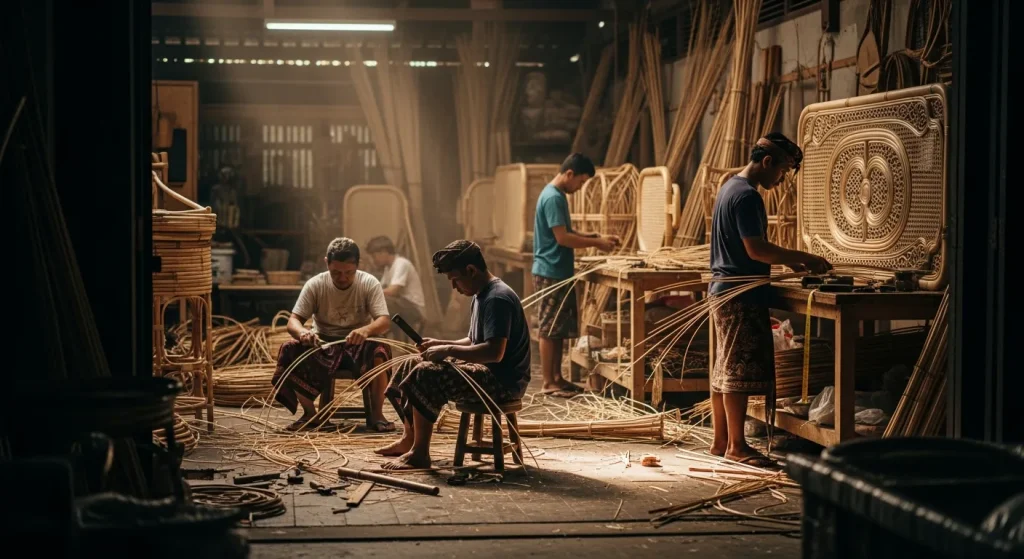
Indonesia, including Bali, remains the leading global production and export hub for wholesale rattan furniture and handicrafts through at least 2027. Buyers sourcing Bali rattan wholesale for indoor/outdoor furniture and home decor, such as rattan pendant lights, will find mid-range pricing and strong growth driven by sustainable material demand and Asia-Pacific supply chain expansion.
Bali Rattan Wholesale Cost Efficiency Strategies for 2027 Buyers
As Ni Kadek Ariani, lead of a rattan weaving co-op and Senior Content Lead for Bali Rattan Wholesale, I provide specific insights into cost efficiency for buyers in 2027. The global rattan furniture wholesale market is a mid-sized and growing sector, with Indonesia, encompassing both Bali and Java, confirmed as the primary production base and export hub until at least 2027. For buyers specifically interested in “Bali rattan wholesale,” this denotes a segment of the Indonesian industry catering to international buyers with container-scale orders. Our offerings span indoor and outdoor furniture, alongside various home decor items, typically positioned within the mid-range of the global market.
2027 Note: Market Leadership and Sustainability
Indonesia’s dominance in the global rattan furniture market is projected to continue through 2027. This leadership is underpinned by the country’s abundant raw material supply, skilled artisan workforce, and established export infrastructure. Buyers in 2027 should anticipate sustained emphasis on sustainable sourcing and ethical production practices, which are becoming increasingly integral to market demand and regulatory frameworks.
Global Market Context: Size and Growth Projections
Industry reports vary on the exact current size of the global rattan furniture market, but there is broad consensus on robust growth and the Asia-Pacific region’s significant role. Estimates for the global rattan furniture market size in 2024 range from USD 3.2 billion to USD 8.75 billion, depending on the specific methodology employed.
- One forecast projects market growth from USD 9.2 billion in 2025 to USD 15.2 billion by 2035, indicating a Compound Annual Growth Rate (CAGR) of approximately 5.2% over this decade.
- Another analysis places the 2024 market value at USD 3.2 billion, anticipating an increase to USD 5.6 billion by 2033, reflecting a CAGR of about 7.2% from 2026 to 2033.
- A separate study suggests a growth of USD 717.2 million between 2023 and 2028, with a CAGR of 2.8%.
Despite these numerical differences, the consistent message is one of steady mid-single-digit growth globally. This growth is predominantly driven by increasing demand for sustainable and natural materials in furniture, strong uptake of outdoor and patio furniture in North America and Europe, and the expansion of supply chains across Asia Pacific, particularly in Indonesia, Malaysia, and Vietnam.
Asia-Pacific and Indonesia’s Role
The Asia-Pacific region is currently the largest regional market, projected to contribute approximately USD 3.5 billion to the total market value in 2024. This growth is fuelled by urbanisation and a regional preference for rattan in both indoor and outdoor applications. One global forecast identifies Asia-Pacific as the fastest-growing region, expected to account for 42.3% of the market’s growth over the forecast period. Indonesia is a key player within this region, holding a dominant position in raw material supply, manufacturing, and export.
Indonesia’s Production and Export Dominance
Indonesia is recognised as the world’s largest producer and exporter of rattan, accounting for approximately 80% of the global raw rattan supply. This substantial resource base provides a competitive advantage. The country’s rattan furniture industry is concentrated in several key regions:
- Cirebon, West Java: The primary production hub, known for its extensive manufacturing capabilities and skilled workforce.
- Surabaya, East Java: Another significant centre for rattan furniture production and export.
- Bali: A key cluster focusing on design-oriented products and catering to specific international buyer segments, including those seeking wholesale rattan pendant lights Bali. Bali’s production is often integrated with broader Indonesian supply chains.
Indonesia’s share of global rattan furniture exports is substantial, estimated to be between 40% and 60% of the total, valued at approximately USD 200–300 million annually. This makes Indonesia the leading global exporter, with a significant margin over competitors such as China, Vietnam, and Malaysia. The country exports to diverse markets, including North America, Europe, Australia, and parts of Asia.
Bali Rattan Wholesale: Specific Considerations
While specific market data for Bali alone is not isolated in global reports, Bali’s rattan furniture and handicraft sector is a notable sub-cluster within Indonesia’s broader industry. Bali operations often leverage the raw material supply and manufacturing base from Java, adding design value and targeting specific international retail and contract markets. Our focus at Bali Rattan Wholesale is on container-scale orders, ensuring efficient logistics and competitive pricing for bulk buyers.
Product Focus: Wholesale Rattan Pendant Lights Bali
Wholesale rattan pendant lights are a significant product category within Bali’s export offerings. These items benefit from the artisanal skills available and the design aesthetic associated with Bali. Buyers focusing on this category can leverage Bali’s position to secure unique designs and consistent quality for container shipments.
Cost Efficiency Strategies for 2027 Buyers
To optimise costs when sourcing from Bali Rattan Wholesale in 2027, buyers should consider the following strategies:
1. Volume-Based Purchasing
Our pricing structure is designed to offer better rates for larger, container-scale orders. Consolidating purchases across various product lines (e.g., furniture, lighting, decor) into full container loads (FCL) reduces per-unit shipping costs significantly. Less than Container Load (LCL) shipments incur higher proportional freight and handling charges.
2. Long-Term Supply Agreements
Establishing long-term supply agreements can provide stability in pricing and production scheduling. These agreements often include preferential terms, particularly during periods of fluctuating raw material costs or high demand.
3. Standardised Product Lines vs. Customisation
While we accommodate customisation, selecting from our existing range of standardised designs, including wholesale rattan pendant lights Bali, can be more cost-effective. Custom designs typically involve additional mould costs, sampling fees, and longer lead times, which impact overall unit cost.
4. Efficient Logistics and Shipping
Understanding and planning for shipping logistics is crucial. We work with established freight forwarders to ensure competitive rates and reliable delivery schedules. Buyers should factor in lead times for production and transit, especially for peak seasons, to avoid expedited shipping surcharges.
5. Strategic Payment Terms
Negotiating favourable payment terms can improve cash flow. While standard terms apply, long-standing relationships and consistent order volumes may allow for more flexible arrangements.
6. Quality Control and Inspection
Investing in pre-shipment inspections can prevent costly returns or rework. Our internal quality control processes are rigorous, but independent third-party inspections can provide an additional layer of assurance for large orders, ensuring products meet specified standards before leaving the factory.
Market Outlook and Competitive Landscape
Indonesia’s competitive advantage in rattan is rooted in its raw material abundance and skilled labour. While other Southeast Asian countries like Vietnam and Malaysia also produce rattan furniture, Indonesia maintains its lead. China, historically a major producer, has seen a decline in its rattan furniture industry due to increasing labour costs and diminishing raw material access, shifting its focus towards synthetic rattan. This scenario reinforces Indonesia’s position as the primary sourcing destination for natural rattan products.
| Country | Primary Advantage | Market Position (2027 Outlook) |
|---|---|---|
| Indonesia (Bali/Java) | Raw material abundance, skilled labour, established export infrastructure | Leading producer and exporter (dominant) |
| Vietnam | Manufacturing capabilities, design focus | Significant exporter (strong competitor) |
| Malaysia | Raw material access, some manufacturing | Niche exporter (moderate) |
| China | Historical production, synthetic rattan focus | Declining natural rattan, synthetic focus (minor for natural) |
Buyers in 2027 will continue to benefit from Indonesia’s robust supply chain and competitive pricing in the mid-range market segment. Focusing on the strategies outlined above will enable efficient and cost-effective procurement of Bali rattan wholesale products, including items like wholesale rattan pendant lights, aligning with global demand for sustainable and natural home furnishings.
For detailed information on our wholesale rattan furniture and handicraft offerings, or to discuss specific requirements for your 2027 purchasing strategy, please request a wholesale quote on WhatsApp. We are prepared to assist with your container-scale orders.