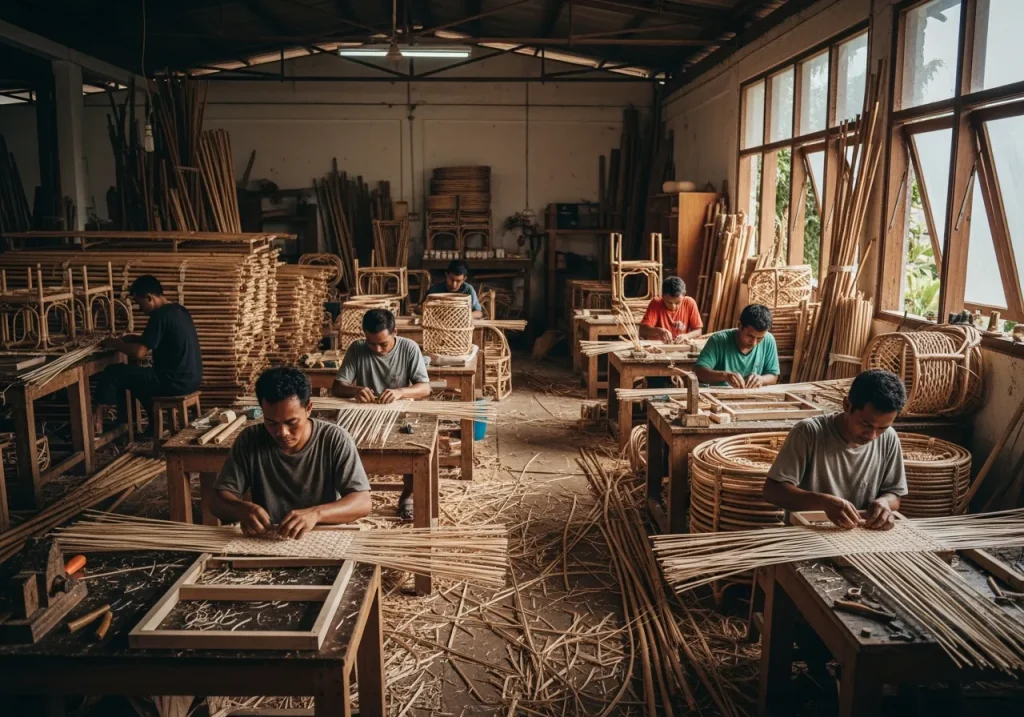
The global rattan furniture wholesale market is projected to grow steadily, with Indonesia, including Bali and Java, established as a primary production and export hub through at least 2027. Buyers seeking ‘Bali rattan wholesale’ should expect container-scale orders of mid-range indoor and outdoor furniture and home decor for international distribution.
Bali Rattan Wholesale Buyer Guide 2027: What to Know Before Ordering
As Ni Kadek Ariani, lead of a rattan weaving co-op and senior content lead for Bali Rattan Wholesale, I provide this guide for importers, wholesalers, retailers, interior contractors, and trade buyers. This information focuses on the Indonesian rattan furniture market, with specific attention to the Bali sub-cluster, based on available industry data.
2027 Note:
By 2027, Indonesia is expected to solidify its position as the leading global supplier of rattan furniture, driven by established supply chains and sustained international demand for natural, sustainable materials. Buyers should anticipate continued strong competition among Indonesian exporters, particularly for mid-range products.
1. Market Size and Growth: Global, Indonesia, and Bali
The global rattan furniture wholesale market is a mid-sized and growing sector. Indonesia is the leading production base and export hub through at least 2027.
Global Rattan Furniture Market Overview
Industry reports vary in exact figures but consistently indicate strong growth and the dominance of the Asia-Pacific region:
- Estimated global market size in 2024 ranges from USD 3.2 billion to USD 8.75 billion, depending on the methodology used.
- One forecast projects growth from USD 9.2 billion in 2025 to USD 15.2 billion by 2035, representing a Compound Annual Growth Rate (CAGR) of approximately 5.2% (2025–2035).
- Another analysis places the 2024 market at USD 3.2 billion, reaching USD 5.6 billion by 2033, with a CAGR of approximately 7.2% (2026–2033).
- A separate report forecasts growth of USD 717.2 million during 2023–2028, at a 2.8% CAGR.
Despite numerical discrepancies, all sources agree on steady mid-single-digit growth globally. This growth is primarily driven by:
- Increasing demand for sustainable, natural materials in furniture production.
- Robust demand for outdoor and patio furniture in North America and Europe.
- Expansion of supply chains within the Asia Pacific region, notably in Indonesia, Malaysia, and Vietnam.
Asia-Pacific and Indonesia’s Role
- Asia-Pacific is the largest regional market, expected to account for approximately USD 3.5 billion of market value in 2024. This is supported by urbanisation and a preference for rattan in both indoor and outdoor settings.
- One global forecast identifies APAC as the fastest-growing region, contributing 42.3% of the global market’s growth.
- Indonesia is a significant contributor to the global rattan furniture supply. The country holds 80% of the world’s raw rattan material.
- Indonesia’s rattan furniture wholesale exports were valued at approximately USD 200 million in 2022. This represents a substantial portion of the global market, estimated between 2% and 6.25% of the total.
- Indonesia’s rattan industry supports an estimated 10 million people across its value chain.
Bali’s Share of the Indonesian Market
Specific market data for Bali as an isolated entity is not available. Bali’s rattan furniture industry is inferred as a sub-cluster within Indonesia’s broader market, primarily serving international buyers with container-scale orders. Bali’s contribution is part of Indonesia’s overall export figures and is known for its focus on mid-range indoor/outdoor furniture and home decor.
2. Product Categories and Materials
Bali rattan wholesale encompasses a range of product types and material combinations.
Product Types
- Indoor Furniture: Sofas, chairs, dining sets, cabinets, beds, room dividers, and decorative items.
- Outdoor Furniture: Patio sets, lounge chairs, daybeds, and garden accessories, often treated for weather resistance.
- Home Decor: Lampshades, baskets, mirrors, and wall art.
Materials Used
- Natural Rattan: The core material, known for its flexibility and durability.
- Synthetic Rattan (Wicker): Often used for outdoor furniture due to its weather resistance and UV protection.
- Combinations: Rattan is frequently combined with other materials such as wood (teak, mahogany), metal (aluminium, steel), glass, and various textiles for cushions and upholstery.
3. Pricing and Quality Considerations
Bali rattan wholesale products are generally priced in the mid-range of the global market.
Pricing Factors
- Material Quality: Grade of rattan, type of wood, and quality of synthetic materials.
- Craftsmanship: Intricacy of weaving, finishing, and structural integrity.
- Design Complexity: Custom designs or more elaborate pieces may incur higher costs.
- Order Volume: Larger container-scale orders typically benefit from better per-unit pricing.
- Treatment and Finishing: Weather-resistant treatments for outdoor furniture, specific stains, or lacquers.
Quality Control
Reputable wholesalers implement rigorous quality control measures from material sourcing to final packaging. Buyers should inquire about the supplier’s quality assurance processes, including checks for:
- Material defects (cracks, inconsistencies).
- Structural stability and joint integrity.
- Consistency of weaving patterns and finishes.
- Compliance with international safety and durability standards.
4. Sourcing and Export Logistics
Understanding the sourcing process and export logistics is crucial for international buyers.
Direct Sourcing vs. Agents
- Direct from Manufacturers/Wholesalers: Offers direct communication, potentially better pricing, and greater control over customisation and quality. This is the primary model for Bali Rattan Wholesale.
- Sourcing Agents: Can assist with supplier identification, quality checks, and logistics, but add an intermediary cost.
Export Documentation and Regulations
Buyers must be aware of the necessary documentation for international shipping:
- Commercial Invoice
- Packing List
- Bill of Lading (for sea freight) or Air Waybill (for air freight)
- Certificate of Origin
- Fumigation Certificate (if required for wood components)
- Phytosanitary Certificate (if required for natural materials)
Compliance with destination country import regulations, including customs duties and product standards, is the buyer’s responsibility.
Shipping Options and Costs
Most wholesale orders are shipped via sea freight in 20-foot or 40-foot containers.
| Container Type | Approximate Volume (CBM) | Typical Use |
|---|---|---|
| 20-foot GP | 33 CBM | Smaller wholesale orders, less bulky items |
| 40-foot GP | 67 CBM | Standard wholesale orders, mixed items |
| 40-foot HC | 76 CBM | Larger wholesale orders, bulky furniture |
Shipping costs vary based on destination, shipping line, and current fuel surcharges. Buyers should request Ex Works (EXW), Free On Board (FOB), or Cost, Insurance, and Freight (CIF) quotes as per their preference.
5. Customisation and Order Process
Bali Rattan Wholesale offers customisation options to meet specific buyer requirements.
Customisation Capabilities
- Design Modifications: Adjustments to dimensions, styles, and configurations of existing products.
- New Product Development: Collaboration on entirely new designs based on buyer specifications and drawings.
- Material and Finish Selection: Choice of rattan types, wood species, fabric colours, and finishes.
Order Process
- Inquiry and Quotation: Buyers submit their requirements, and a detailed quote is provided.
- Sampling (Optional): For custom designs or large orders, a sample may be produced for approval.
- Order Confirmation: A purchase order (PO) is issued, and a down payment (typically 30-50%) is made.
- Production: Manufacturing commences according to agreed specifications. Production lead times vary but are typically 8-12 weeks, depending on order size and complexity.
- Quality Inspection: Pre-shipment inspection (PSI) is conducted.
- Final Payment: The remaining balance is paid upon satisfactory inspection or before shipment.
- Shipping and Documentation: Goods are shipped, and necessary export documents are provided.
6. Sustainability and Ethical Sourcing
As a natural material, rattan offers inherent sustainability advantages. Buyers should consider suppliers committed to ethical practices.
Environmental Considerations
- Renewable Resource: Rattan grows quickly and regenerates naturally in tropical forests.
- Sustainable Harvesting: Responsible sourcing ensures rattan is harvested without harming the forest ecosystem.
- Low Carbon Footprint: Compared to synthetic materials, natural rattan production generally has a lower environmental impact.
Social Responsibility
- Fair Labour Practices: Supporting suppliers who provide fair wages, safe working conditions, and do not employ child labour.
- Community Impact: Many rattan producers, like our co-op, support local communities and traditional craftsmanship.
We invite you to discuss your wholesale requirements directly with Bali Rattan Wholesale. Request a wholesale quote on WhatsApp to begin your order process.